
Study: Mormonism (9/27/26)
Prayer Points
Health of Ministry Staff and Key leaders...
Psalm 62.8“Trust in him at all times; ye people, pour out your heart before him: God is a refuge for us. Selah.”
Children's Ministry...
Psalm 145.18–19 — “The LORD is nigh unto all them that call upon him, to all that call upon him in truth. He will fulfil the desire of them that fear him: he also will hear their cry, and will save them.”
Affinity Ministries
Psalm 86.6–7 — “Give ear, O LORD, unto my prayer; and attend to the voice of my supplications. In the day of my trouble I will call upon thee: for thou wilt answer me.”
Introduction (3:00)
Most of us have met the missionaries.
`Two young men in white shirts and black name tags...
On bicycles...
Polite, clean-cut, and remarkably persistent...
And most of us know a few unusual things they believe...
`Golden plates...
`Polygamy...
`Mormon underwear
Utah...
But most Christians could not clearly explain:
What Latter-day Saints actually believe about God...
Why the Book of Mormon is not simply "another Bible"...
Or why a religion that talks about Jesus constantly is not preaching the Jesus of the Bible.
Why this matters here...
Texas has hundreds of thousands of Latter-day Saints on the rolls, with temples in Dallas, Houston, San Antonio, Lubbock, and McAllen, and more announced.
`Many of you have an LDS coworker, neighbor, classmate, or relative, whether you know it or not.
`And missionaries are assigned to this area.
`Sooner or later you will likely meet them.
Last week and this week...
`Jehovah's Witnesses and Latter-day Saints have a lot in common.
`Both began in nineteenth-century America.
`Both claim the church fell into total apostasy after the apostles died.
`Both claim to have restored the true church through a modern prophetic authority.
`Both use our vocabulary with different definitions.
But here is the contrast to keep in mind all night:
Jehovah's Witnesses subtract from Christ. Mormonism adds to him.
One shrinks Jesus down to a created being.
The other promises that you can become what he is.
Same ground rules as before...
`Our goal is not to mock Latter-day Saints or make them look foolish.
`Many are sincere, moral, generous, family-centered, and hard-working.
`They deserve to have their beliefs represented accurately, from their own sources.
Tonight, nearly every quotation comes from their own scriptures, their own prophets, and their own official website.
`But sincerity does not make a belief true.
And when the questions involve who God is, who Jesus is, and how a person is saved, the differences are not minor.
So tonight I want to do five things:
Give you a brief overview of who the Latter-day Saints are and where they came from.
Explain the most important things they believe.
Look briefly at some of their distinctive practices.
Flag the vocabulary that will confuse you.
And most importantly, talk about how we can lovingly and faithfully share the gospel with them.
Our Goal
Our goal is not merely to know what Latter-day Saints get wrong.
Our goal is to know the truth well enough that we can recognize error and lovingly point people to Jesus Christ.
1 Peter 3.15 | but in your hearts regard Christ the Lord as holy, ready at any time to give a defense to anyone who asks you for a reason for the hope that is in you. (CSB)
`I'm going to move pretty quickly through beliefs because you can find better stuff online.
`Alyssa Grenfell – Evidence The Book of Mormon is False
I. Ten Top Facts About the History of Latter-Day Saints (8:00)
1. The church was founded in upstate New York in 1830, and since 2018 it does not want to be called "Mormon."
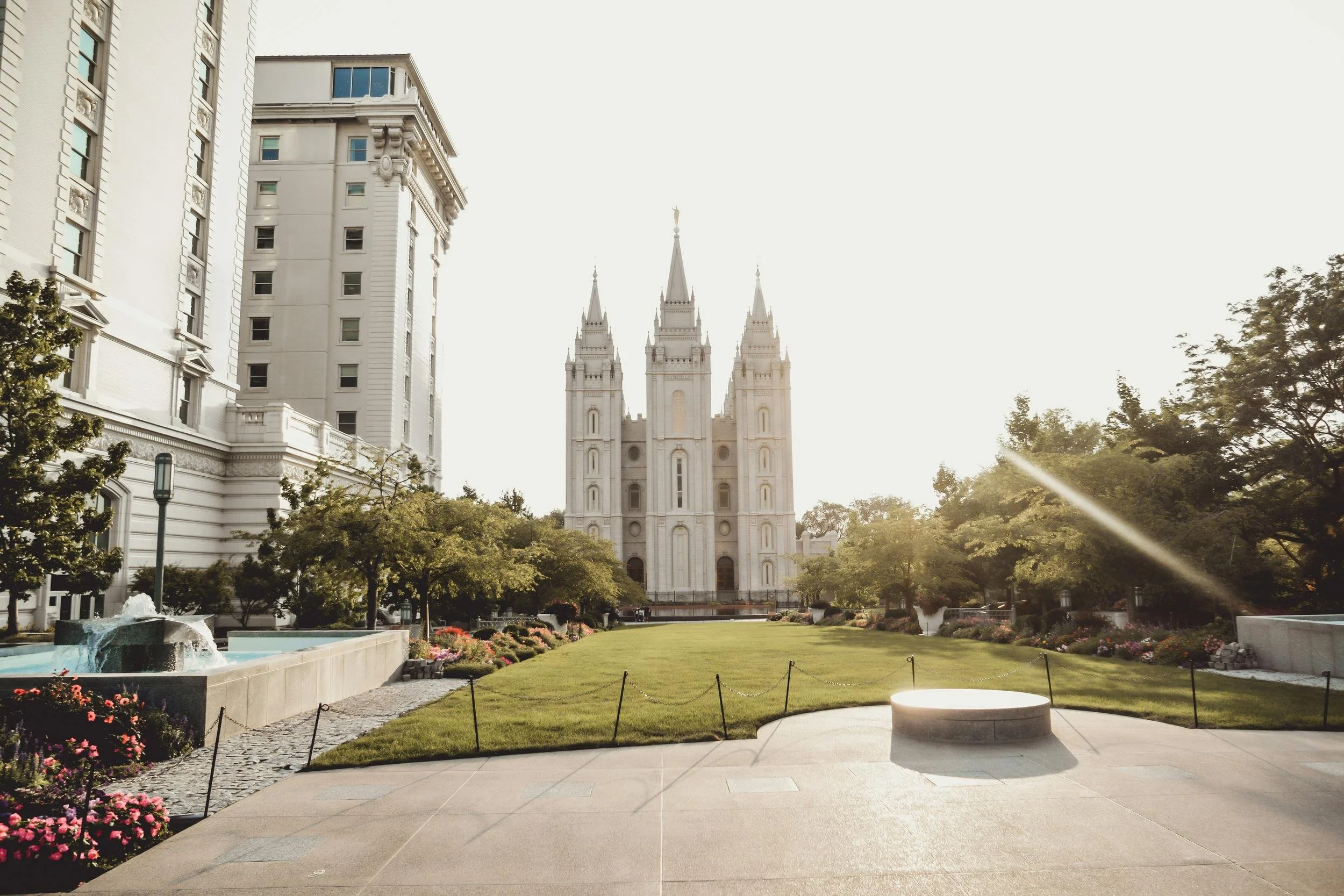
The Church of Jesus Christ of Latter-day Saints is a restorationist, non-Trinitarian, Christian cult founded in upstate New York in 1830 and headquartered in Salt Lake City, Utah.
Restorationist. Like the Jehovah's Witnesses, they believe the true church disappeared from the earth after the apostles and was restored through them. Their claim is more sweeping. They claim the priesthood authority itself was lost.
Non-Trinitarian. But in the opposite direction from the Jehovah's Witnesses. Latter-day Saints say the Father, the Son, and the Holy Ghost are three separate beings, united as one "Godhead" in purpose but not in being.
Not "Protestant," not a "denomination." Their claim is that every church, Catholic and Protestant alike, lost the authority of God, and only they have it back.
`"Mormon" comes from the Book of Mormon, named for Mormon, the prophet who supposedly compiled it.
`In August 2018, President Russell M. Nelson announced that the church no longer wants to be called "Mormon" or "LDS."
He said, "To remove the Lord's name from the Lord's Church is a major victory for Satan."
This is a reversal. From 2010 to 2018 the church ran a worldwide advertising campaign called "I'm a Mormon."
Out of courtesy, I will mostly say "Latter-day Saints" tonight, though your friends will know exactly what you mean by "Mormon."
Notice why the name matters so much to them. The full name says, "We are Christians, and we are the true Church of Jesus Christ." That is precisely the question tonight.
2. Joseph Smith was a treasure seeker before he was a prophet.
Joseph Smith Jr. was born in 1805 in Sharon, Vermont. In 1816 the family moved to Palmyra, New York, in the "burned-over district," a region swept repeatedly by revivals.
Know the soil: religious excitement, competing preachers, folk magic, and a hunger for certainty.
The Smiths were poor farmers who mixed folk religion with Christianity. Dreams, visions, divining rods, and seer stones were part of the household.
As a young man he worked as a treasure seeker, using a "seer stone" placed in a hat to locate buried money for hire.
In 1826 he was examined in court in Bainbridge, New York, as a "glass looker."
The point is simply that the stone-in-the-hat method predates the plates.
The church's own 2015 Ensign article "Joseph the Seer" acknowledges his early use of seer stones to search for treasure.
3. Everything rests on the First Vision (1820), and the story grew in the telling.
Joseph said God the Father and Jesus Christ appeared to him in a grove of trees and told him to join none of the churches.
Joseph Smith–History 1.19: "...the Personage who addressed me said that all their creeds were an abomination in his sight; that those professors were all corrupt."
This is the founding event of the religion. But there are problems.
The earliest surviving written account dates to twelve years after the reported event.
The earliest surviving account, written in 1832, explicitly describes only "the Lord" appearing.
It emphasizes forgiveness of Joseph's sins and differs from the later official account, which explicitly identifies two personages and includes the instruction to join none of the churches.
The official account (1838) has two personages.
The church's own Gospel Topics essay, "First Vision Accounts," acknowledges the differences.
The church's explanation is that the accounts are like the four Gospels, told with different emphases to different audiences.
My own reading, shared by many historians, is that the story grew in the telling. The version everyone knows was written eighteen years after the fact, after Joseph had come to teach that the Father and the Son are separate personages.
Why it matters: the church itself says everything stands or falls here.
Gordon B. Hinckley (October 2002): "Our whole strength rests on the validity of that vision. It either occurred or it did not occur. If it did not, then this work is a fraud."
4. The golden plates were never available for examination, and the "translation" came from a stone in a hat.
`1823, the angel Moroni. Joseph said an angel told him about golden plates buried in a hill near his home. In 1827 he retrieved the plates.
Gold-colored plates about six inches by eight inches, several inches thick, bound with rings, with part of the record "sealed." If solid gold they would have weighed well over 100 pounds. Witnesses estimated about 60 pounds.
`No one was allowed to see them except the witnesses, and Joseph said he returned them to the angel when he was finished. There is nothing to examine.
`The plates were said to be written in "Reformed Egyptian," a language unknown to any scholar.
The accounts of much of the dictation do not describe Joseph reading from the plates. He put his seer stone (or the "interpreters") in a hat, put his face in the hat, and dictated.
The plates were often covered with a cloth or not in the room at all.
Emma Smith, his wife and one of his scribes, in 1879: the plates "often lay on the table without any attempt at concealment, wrapped in a small linen table cloth," while Joseph sat "with his face buried in his hat, with the stone in it, and dictating hour after hour with nothing between us."
The stone he used for treasure hunting was the stone he used for the Book of Mormon. Younger Latter-day Saints know this now. Older members often do not.
1828, the 116 lost pages. Martin Harris lost the first manuscript. Joseph did not re-translate it. He produced a different account instead. The result is that no comparison of the two versions was ever possible.
The witnesses.
The Three Witnesses (Oliver Cowdery, David Whitmer, Martin Harris) were all later excommunicated or left the church. Two eventually returned. But note what "seeing" meant. Their printed testimony says an angel came down from heaven and laid the plates before their eyes, and that they saw them "by the power of God." It describes a supernatural encounter, not an ordinary inspection.
The Eight Witnesses: four Whitmers, one Whitmer son-in-law, and Joseph's father and two brothers. Every one was family or in-law.
5. The priesthood was "restored" in 1829, and by their own logic the whole church stands or falls on it.
`John the Baptist supposedly appeared and conferred the Aaronic Priesthood. The Aaronic event is dated May 15, 1829, on the bank of the Susquehanna River.
Peter, James, and John supposedly appeared and conferred the Melchizedek Priesthood. The Melchizedek event has no recorded date.
The detailed accounts naming John the Baptist and Peter, James, and John first appeared in print in 1834–35, five or six years after the events.
David Whitmer, who was there in 1829, later said he never heard of an angelic priesthood restoration until years afterward.
Why it matters: this is the "authority" the entire church rests on.
If there was no restored priesthood, there are no valid LDS ordinances, no valid temple, and no reason for the church to exist.
That is their own logic, not ours.
`March 1830, the Book of Mormon was published.
April 6, 1830, the church was organized in Fayette, New York, with six founding members.
Joseph was sustained as "a seer, a translator, a prophet, an apostle of Jesus Christ" (Doctrine and Covenants 21.1).
Kirtland and Missouri (1831–1839): a failed bank, a checkable "translation," a failed prophecy, and real persecution.
Kirtland, Ohio. First temple built.
Joseph founded a bank, the Kirtland Safety Society, which collapsed in 1837. He fled Ohio to avoid creditors and lawsuits.
Hundreds left, including several apostles and all three of the Book of Mormon witnesses.
In 1835 Joseph bought Egyptian papyri and "translated" them as writings of Abraham. They are canonized scripture in the Pearl of Great Price.
The papyri were thought lost, but fragments were rediscovered in 1967.
Egyptologists, including LDS ones, identify the surviving fragments as ordinary Egyptian funerary texts written roughly 1,800 years or more after Abraham. They say nothing about Abraham.
The church's own 2014 essay, "Translation and Historicity of the Book of Abraham," concedes this and proposes other theories of how "translation" might be understood.
Why it matters: this is the one "translation" by Joseph Smith where some of the source material survives and can be read independently, and the Egyptian text on the surviving fragments does not match the Book of Abraham.
Missouri. Joseph declared Independence, Missouri, to be Zion and prophesied that a temple would be built there "in this generation."
Doctrine and Covenants 84.4–5 (1832): "...which temple shall be reared in this generation. For verily this generation shall not all pass away until an house shall be built unto the Lord..."
It was never built. The site is owned by another group.
Deuteronomy 18.22 | When a prophet speaks in the LORD's name, and the message does not come true or is not fulfilled, that is a message the LORD has not spoken. The prophet has spoken it presumptuously. Do not be afraid of him." (CSB)
1838, the "Mormon War," Governor Boggs's extermination order, and Joseph jailed in Liberty, Missouri.
Governor Lilburn Boggs (October 27, 1838): "The Mormons must be treated as enemies, and must be exterminated or driven from the State." Three days later a Missouri militia killed seventeen Latter-day Saints, including children, at Haun's Mill.
The Latter-day Saints were often the victims of real persecution, and they remember it.
7. Nauvoo (1839–1846): Freemasonry, the temple endowment, and secret polygamy.
The Saints built a city of roughly 12,000, one of the largest in Illinois.
Joseph was mayor, lieutenant general of his own militia, and in 1844 a candidate for President of the United States.
March 1842, Joseph became a Freemason.
May 1842, he introduced the temple endowment ceremony, which borrowed heavily from Masonic ritual.
Plural marriage was practiced secretly.
The church's own essay, "Plural Marriage in Kirtland and Nauvoo," acknowledges Joseph married 30 to 40 women, some of whom were already married to living husbands, and the youngest of whom was 14.
Publicly, Joseph and the church denied it.
The revelation on plural marriage was recorded July 12, 1843, and is still canonized as Doctrine and Covenants 132.
A month before his death (May 26, 1844), according to the published account of his sermon, Joseph said publicly: "What a thing it is for a man to be accused of committing adultery, and having seven wives, when I can only find one." By then he had entered dozens of plural marriages.
April 1844, the King Follett Discourse, where Joseph taught that God was once a man. (More on that shortly.)
8. Joseph Smith died in Carthage Jail in 1844, armed and awaiting trial.
June 1844, Joseph ordered the destruction of a newspaper, the Nauvoo Expositor, that exposed his polygamy.
He was charged with riot, posted bail, and was then jailed in Carthage, Illinois, on a charge of treason for declaring martial law in Nauvoo. He was never tried.
`On June 27, 1844, a mob stormed the jail and killed him and his brother Hyrum.
Doctrine and Covenants 135.3: "Joseph Smith, the Prophet and Seer of the Lord, has done more, save Jesus only, for the salvation of men in this world, than any other man that ever lived in it."
Joseph did not die unarmed. He fired a six-shot pistol smuggled into the jail, hitting two or three men in the mob. Latter-day Saints know this; most outsiders do not.
`In LDS retelling he is "the martyr," and Doctrine and Covenants 135 says he "sealed his testimony with his blood."
His death was a lynching, and it was wrong.
But it came in the middle of a tangle of religious, political, and legal conflict, while he was awaiting trial on charges arising from his own actions.
Whatever we call it, a violent death does not establish the truth of his prophetic claims. Stephen's death proved nothing about Stephen's message; the message stood on its own.
9. Brigham Young took the church to Utah, where polygamy was public for forty years and Black members were barred from the priesthood until 1978.
Brigham Young led the majority west. They entered the Salt Lake Valley on July 24, 1847.
Other groups broke away, including the Reorganized Church (now Community of Christ) under Joseph's son. When you hear "Mormon," it almost always means the Utah church.
1852, plural marriage publicly announced. Brigham Young had 55 wives.
For the next forty years the church defended polygamy as essential to exaltation.
Brigham Young (1866): "The only men who become Gods, even the Sons of God, are those who enter into polygamy." (Journal of Discourses 11.269)
1890, the Manifesto officially ended plural marriage (under federal pressure; Utah became a state in 1896).
The Manifesto (now Official Declaration 1 in the Doctrine and Covenants) did not call polygamy wrong. It announced the church would stop performing new plural marriages.
`Today anyone practicing polygamy is excommunicated. But Doctrine and Covenants 132 remains scripture, the church still defends the plural marriages of Joseph and Brigham as divinely commanded, and a man whose wife dies may be sealed in the temple to a second wife for eternity.
The practice is prohibited. The principle has never been called false.
1852, Black members barred from the priesthood and the temple.
Brigham Young instituted the ban in 1852, teaching that Black people bore the curse of Cain.
1978, the priesthood ban was lifted. The church's 2013 essay "Race and the Priesthood" disavows the reasons formerly taught.
10. Today the church has 17.9 million members on the rolls, 204 temples, a living prophet, enormous wealth, and a push to sound Christian.
About 17.9 million members on the rolls at the end of 2025. Actual participation is far lower than the rolls.
88,500 full-time teaching missionaries (a mid-2026 figure), plus about 10,500 service missionaries.
204 operating temples at the end of 2025, plus 7 in renovation and 172 announced or under construction, for 383 in all.
Led by President Dallin H. Oaks (since October 2025), regarded as a living prophet, seer, and revelator.
The church has enormous wealth.
In 2023 the SEC fined the church and its investment arm $5 million for hiding its stock holdings behind shell companies. The whole fund has been estimated at well over $100 billion.
The church also reports over a billion dollars a year in humanitarian and welfare spending, and its welfare system (Bishop's Storehouses, Deseret Industries) is real and effective. Both things are true.
Where the members are: roughly 7 million in the United States, concentrated in Utah, Idaho, Arizona, Nevada, and Wyoming. Fast growth in Latin America, the Philippines, and Africa.
Where they are headed: the church's emphasis over the last decade under Nelson and now Oaks is the full name of the church, temples everywhere, "the covenant path," and presenting the church as thoroughly Christian and Christ-centered. Expect your LDS friends to sound more like evangelicals than their grandparents did.
II. Ten Top Facts About Latter-Day Saints Beliefs (8:00)
1. They have four books of scripture, and the Bible is the only one with a qualifier.
Latter-day Saints have four "Standard Works":
The Bible (King James Version)
The Book of Mormon
Doctrine and Covenants (revelations, mostly to Joseph Smith)
The Pearl of Great Price (Book of Moses, Book of Abraham, Joseph Smith–History, Articles of Faith)
The Bible. They use the King James Version with their own chapter headings, footnotes, and a Bible Dictionary. The footnotes routinely reinterpret verses to fit LDS doctrine.
Joseph also produced his own revision of the Bible (1830–1833), the "Joseph Smith Translation," changing about 3,400 verses without any manuscript evidence. Among the additions: a prophecy in Genesis 50 that a future seer named Joseph, son of a father named Joseph, would arise. Joseph Smith wrote himself into Genesis.
Article of Faith 8: "We believe the Bible to be the word of God as far as it is translated correctly; we also believe the Book of Mormon to be the word of God."
Notice the qualifier. It only applies to the Bible.
Whenever the Bible contradicts them, the Bible is "mistranslated" or "corrupted."
Ask the obvious question: which verses, and where is the evidence? We have thousands of Greek manuscripts, some from within a century of the originals. No lost doctrine of exaltation, pre-existence, or temple ordinance shows up in any of them.
2. The living prophet outranks the scriptures, so doctrine can change without embarrassment.
Ezra Taft Benson, "Fourteen Fundamentals in Following the Prophet" (1980):
"The living prophet is more vital to us than the standard works."
"The living prophet is more important to us than a dead prophet."
Wilford Woodruff, in the statements attached to Official Declaration 1: "The Lord will never permit me or any other man who stands as President of this Church to lead you astray."
The practical result: the current prophet's word settles what earlier prophets, and even the standard works, mean. This is how a church with a fixed canon can still change almost anything.
This is why doctrine can change without embarrassment: polygamy, the priesthood ban, Brigham Young's teaching that Adam is God, and repeated revisions of the temple ceremony (1990, 2019).
Adam-God: Brigham Young taught (1852) that Adam is "our Father and our God, and the only God with whom we have to do" (Journal of Discourses 1:50). Spencer W. Kimball (1976) publicly denounced "the Adam-God theory" as false doctrine. One prophet's revelation became another prophet's heresy.
A fair note: Latter-day Saints will tell you that prophets are not infallible and sometimes speak as men. True. But then how do you know which statements are revelation and which are opinion? The only answer is: whatever the current leadership says. The living prophet judges the dead ones.
Jude 3 | Dear friends, although I was eager to write you about the salvation we share, I found it necessary to write, appealing to you to contend for the faith that was delivered to the saints once for all. (CSB)
3. The Book of Mormon claims to be an ancient American record, but it contains almost none of the distinctive LDS doctrines.
A record of an Israelite family that left Jerusalem around 600 BC, wandered the Arabian wilderness, built a ship, and crossed the ocean to the Americas.
Their descendants (the Nephites and the Lamanites) spread across the land, were visited by the risen Christ, and fought until the Nephites were destroyed around AD 385.
Moroni, the last Nephite, finished the record and buried the plates around AD 421. Fourteen hundred years later he came back as an angel to give them to Joseph Smith.
The subtitle "Another Testament of Jesus Christ" was added in 1982.
Joseph Smith, in the book's Introduction: "...the most correct of any book on earth, and the keystone of our religion, and a man would get nearer to God by abiding by its precepts, than by any other book."
`Surprising fact: the Book of Mormon contains almost none of the distinctive LDS doctrines.
To be specific, the Book of Mormon does not teach that God was once a man, that there are many gods, that humans can become gods, that there is a Heavenly Mother, that there are three kingdoms of heaven, that marriage is eternal, that baptism can be performed for the dead, or that a temple endowment is required. Every one of those developed between 1832 and Joseph's death in 1844, and some were first written down only afterward.
`In fact, the Book of Mormon often sounds closer to us than to them:
2 Nephi 31.21: "...the Father, and of the Son, and of the Holy Ghost, which is one God, without end."
Moroni 8.18: "For I know that God is not a partial God, neither a changeable being; but he is unchangeable from all eternity to all eternity."
Joseph's theology changed after 1830, and he revised the book to fit. 1830 edition, 1 Nephi 11.18: "the virgin whom thou seest is the mother of God." 1837 and after: "the mother of the Son of God."
The King James Version is inside it.
Long stretches of Isaiah appear in 1611 English, nearly word for word, including the KJV's translation choices and even words the KJV translators supplied in italics because they are not in the Hebrew.
3 Nephi 12–14 is Matthew 5–7 in KJV English. Whole phrases from Paul, Peter, Hebrews, and Revelation appear in the mouths of Nephite prophets who lived centuries before those letters were written.
No archaeology. Not one city, coin, inscription, or artifact has ever been identified. Compare that to the Bible. You can walk through Capernaum, Jericho, and Hezekiah's tunnel today. Biblical kings show up in Assyrian records. Pilate's name is on a stone in Caesarea.
4. The test of truth is a feeling.
The missionaries will ask you to read it and pray about it.
Moroni 10.4: "...ask God, the Eternal Father, in the name of Christ, if these things are not true; and if ye shall ask with a sincere heart, with real intent, having faith in Christ, he will manifest the truth of it unto you, by the power of the Holy Ghost."
The foundation of an LDS "testimony" is a feeling.
"I know the Church is true. I know Joseph Smith was a prophet."
On the first Sunday of each month, members (including small children, coached by parents) stand and "bear testimony" using this formula.
The Bible never tells us to test a message by a feeling. It tells us to test feelings by the message.
Acts 17.11 | The people here were of more noble character than those in Thessalonica, since they received the word with eagerness and examined the Scriptures daily to see if these things were so. (CSB)
1 Thessalonians 5.21 | but test all things. Hold on to what is good. (CSB)
Jeremiah 17.9 | The heart is more deceitful than anything else, and incurable—who can understand it? (CSB)
5. They believe the true church vanished for 1,700 years until Joseph Smith restored it.
After the apostles died, the church fell into complete apostasy. The priesthood authority was lost. For about 1,700 years there was no true church on earth.
God restored the church through Joseph Smith in 1830.
Think about what that means. Every Christian from the second century to 1830, including Augustine, Luther, Calvin, Bunyan, Wesley, and every Baptist who ever lived before Joseph Smith, belonged to a corrupt church with no valid baptism and no authority.
Christ promised that his church would never fail.
Matthew 16.18 | And I also say to you that you are Peter, and on this rock I will build my church, and the gates of Hades will not overpower it. (CSB)
Matthew 28.20 | teaching them to observe everything I have commanded you. And remember, I am with you always, to the end of the age." (CSB)
If the gates of Hades won the day around AD 100 and held the field for seventeen centuries, Jesus was wrong.
Hebrews 1.1-2 | Long ago God spoke to our ancestors by the prophets at different times and in different ways. In these last days, he has spoken to us by his Son. God has appointed him heir of all things and made the universe through him. (CSB)
God's final and definitive word is his Son. A new prophet with new scripture that overrules the Son's own apostles is a step backward from Hebrews 1.
The apostasy claim also proves too much. If a total apostasy could happen in the first century to the apostles' own converts, why could it not happen to Joseph Smith's church? Latter-day Saints answer that the prophet will never lead the church astray. But that is exactly what they say the early church's leaders did.
God the Father is an exalted man who was once mortal, and he is one of many gods.
God the Father (they call him Elohim) is an exalted man with a physical body.
Doctrine and Covenants 130.22: "The Father has a body of flesh and bones as tangible as man's; the Son also; but the Holy Ghost has not a body of flesh and bones, but is a personage of Spirit."
God was not always God. He was once a mortal man on another world who progressed to godhood.
Joseph Smith, King Follett Discourse (April 1844): "God himself was once as we are now, and is an exalted man, and sits enthroned in yonder heavens! That is the great secret... I am going to tell you how God came to be God. We have imagined and supposed that God was God from all eternity. I will refute that idea, and take away the veil, so that you may see."
Lorenzo Snow, fifth president of the church, put it in a couplet still quoted today: "As man now is, God once was; as God now is, man may be."
In 1997, President Gordon B. Hinckley told Time magazine: "I don't know that we teach it. I don't know that we emphasize it. I haven't heard it discussed for a long time in public discourse." But the church's own 2014 essay, "Becoming Like God," quotes the couplet approvingly and affirms the doctrine.
There is a Heavenly Mother. God the Father has a wife (or wives), and we are their literal spirit children.
There are many gods. Latter-day Saints worship only the God of this world, but they believe he has a Father, who has a Father, and so on.
The Trinity is rejected. Father, Son, and Holy Ghost are three separate beings who are "one" only in purpose and will. They call this the "Godhead," never "the Trinity."
Biblical and historical Christianity affirm there is one God, eternal, uncreated, unchanging, and spirit.
Isaiah 43.10 | "You are my witnesses"—this is the LORD's declaration—"and my servant whom I have chosen, so that you may know and believe me and understand that I am he. No god was formed before me, and there will be none after me. (CSB)
Psalm 90.2 | Before the mountains were born, before you gave birth to the earth and the world, from eternity to eternity, you are God. (CSB)
John 4.24 | God is spirit, and those who worship him must worship in Spirit and in truth."(CSB)
Notice: on this point the Book of Mormon (Moroni 8.18) agrees with the Bible against Joseph Smith.
The key question: Was there ever a time when God was not God? The Bible says no. Joseph Smith says yes. Everything else follows from this.
7. Jesus is the firstborn spirit child of Heavenly Parents, the elder brother of every human being, and of Lucifer.
Jesus is the firstborn spirit child of Heavenly Father and Heavenly Mother in the pre-mortal world.
He is therefore the elder brother of every human being. And of Lucifer.
Ensign magazine, June 1986: "...both the scriptures and the prophets affirm that Jesus Christ and Lucifer are indeed offspring of our Heavenly Father and, therefore, spirit brothers."
Jesus progressed to godhood before his birth. He is the Jehovah of the Old Testament, a separate being from Elohim, the Father. He is one of three gods, not the one true God incarnate.
Latter-day Saints do not pray to Jesus. Prayers are addressed to Heavenly Father, "in the name of Jesus Christ."
Some things they do affirm, so you are not surprised: the virgin birth, Jesus's sinless life, his miracles, his literal bodily resurrection, and his return. Their Jesus is high. He is simply not God in the sense the Bible means, and he is not unique in kind.
Gordon B. Hinckley, then president of the church, in 1998: "...the traditional Christ of whom they speak is not the Christ of whom I speak. For the Christ of whom I speak has been revealed in this the Dispensation of the Fulness of Times."
Biblical and historical Christianity affirm Jesus is the eternal, uncreated Son of God, fully God and fully man, the Creator of everything that exists, including Lucifer.
John 1.1 | In the beginning was the Word, and the Word was with God, and the Word was God. (CSB)
John 1.3 | All things were created through him, and apart from him not one thing was created that has been created. (CSB)
Colossians 2.9 | For the entire fullness of God's nature dwells bodily in Christ, (CSB)
When a Latter-day Saint says "I believe in Jesus Christ... I believe Jesus is the Son of God... I believe Jesus is my Savior," they do not mean what biblical and historical Christianity mean.
For the missionary at your door, that is not usually deception. They believe what they have been taught. But you cannot assume you agree just because the words match.
2 Corinthians 11.4 | For if a person comes and preaches another Jesus, whom we did not preach, or you receive a different spirit, which you had not received, or a different gospel, which you had not accepted, you put up with it splendidly! (CSB)
Galatians 1.8 | But even if we or an angel from heaven should preach to you a gospel contrary to what we have preached to you, a curse be on him! (CSB)
Do not miss the irony. This entire religion rests on an angel from heaven who delivered a different gospel.
8. Every human being is a pre-existent spirit child of God, the fall was a step forward, and there is no original sin.
Every human being existed before birth as a spirit child of Heavenly Parents. Humans and God are the same kind of being at different stages of progression.
The fall of Adam was a good thing, a necessary step forward.
2 Nephi 2.25: "Adam fell that men might be; and men are, that they might have joy."
There is no original sin.
Article of Faith 2: "We believe that men will be punished for their own sins, and not for Adam's transgression."
Children are innocent until age eight, when they are baptized.
The purpose of this life is to prove ourselves worthy to return to God's presence and progress toward what he is. Earth is a school, not a rescue.
Biblical and historical Christianity affirm we are creatures, made by God, not gods in embryo, and the fall was a catastrophe.
Psalm 100.3 | Acknowledge that the LORD is God. He made us, and we are his—his people, the sheep of his pasture. (CSB)
Psalm 51.5 | Indeed, I was guilty when I was born; I was sinful when my mother conceived me.(CSB)
If you get man wrong, you will get salvation wrong. A small view of sin always produces a small view of grace.
"Salvation" means two different things, and the one that matters is obtained by obedience.
General salvation (or "immortality"): everyone will be resurrected because of Christ's atonement. Unconditional. By grace. When a Latter-day Saint says "Jesus saved everyone," this is what they mean.
Exaltation (or "eternal life"): living forever in the presence of God in the highest level of the celestial kingdom, married for eternity, becoming a god, and producing spirit children to populate your own worlds.
Doctrine and Covenants 132.20: "Then shall they be gods, because they have no end; therefore shall they be from everlasting to everlasting, because they continue; then shall they be above all, because all things are subject unto them. Then shall they be gods, because they have all power, and the angels are subject unto them."
This is the goal of Mormonism. Not to be with God. To become one.
How is exaltation obtained?
Article of Faith 3: "We believe that through the Atonement of Christ, all mankind may be saved, by obedience to the laws and ordinances of the Gospel."
The requirements include faith, repentance, baptism by LDS priesthood authority, the gift of the Holy Ghost by laying on of hands, the temple endowment, temple marriage, tithing, the Word of Wisdom, keeping the covenants, and "enduring to the end."
2 Nephi 25.23: "...for we know that it is by grace that we are saved, after all we can do."
The LDS Bible Dictionary, entry "Grace": "This grace is an enabling power that allows men and women to lay hold on eternal life and exaltation after they have expended their own best efforts."
Latter-day Saints have historically emphasized Gethsemane, where Jesus bled from every pore, as the center of the atonement. In their system, the atonement makes exaltation possible. Obedience makes it actual.
`A fair note: since the 1990s, Latter-day Saints have talked much more about grace. Your LDS friend may sound very evangelical on this point.
But in LDS teaching, grace is an enabling power that helps you become worthy. It is not God's free justification of the ungodly through faith alone.
Ask: "Is there anything I must do, beyond trusting Christ, to be exalted?" The honest answer is always yes.
Biblical and historical Christianity affirm...
Ephesians 2.8 | For you are saved by grace through faith, and this is not from yourselves; it is God's gift— (CSB)
Ephesians 2.9 | not from works, so that no one can boast. (CSB)
Romans 4.5 | But to the one who does not work, but believes on him who justifies the ungodly, his faith is credited for righteousness. (CSB)
Hebrews 10.14 | For by one offering he has perfected forever those who are sanctified. (CSB)
Not "after all we can do." Instead of all we can do.
Mormonism turns salvation into a ladder to godhood that you climb by obedience. The Bible presents salvation as a rescue of sinners by a God who never stops being God and never shares his deity (Isaiah 42.8). Believers will share Christ's glory (Romans 8.17; John 17.22), but as glorified creatures, never as gods.
John 17.3 | This is eternal life: that they may know you, the only true God, and the one you have sent—Jesus Christ. (CSB)
Almost no one ends up in hell, and the dead can still be saved by proxy.
At death, spirits go to the spirit world, divided into paradise (for the faithful) and spirit prison (for everyone else).
Missionary work continues in the spirit world. The dead who accept the LDS gospel can be saved.
Ordinances (baptism, endowment, sealing) are performed by proxy for the dead in temples so they can accept them.
After resurrection and judgment, nearly everyone goes to one of three kingdoms of glory (Doctrine and Covenants 76):
Celestial: faithful Latter-day Saints. The highest level, where exaltation happens, requires temple marriage.
Terrestrial: honorable people who rejected the LDS gospel, and lukewarm Latter-day Saints.
Telestial: the wicked, after a period of suffering. Even this kingdom's glory "surpasses all understanding" (Doctrine and Covenants 76.89).
Outer darkness is reserved for Satan, his angels, and a handful of "sons of perdition," people who knew the truth fully and denied it.
In practice, Mormonism is very nearly universalism. Almost no one is finally lost.
Hell, for a Latter-day Saint, usually means the temporary suffering of spirit prison before the telestial kingdom. When they say "I don't believe in hell the way you do," this is what they mean.
Biblical and historical Christianity affirm...
Hebrews 9.27 | And just as it is appointed for people to die once—and after this, judgment—(CSB)
Luke 16.26 | Besides all this, a great chasm has been fixed between us and you, so that those who want to pass over from here to you cannot; neither can those from there cross over to us.'(CSB)
Matthew 25.46 | "And they will go away into eternal punishment, but the righteous into eternal life." (CSB)
III. Five Distinctive Latter-Day Saint Practices (7:00)
Missionaries
Young men serve two years beginning at 18. Young women serve eighteen months, also beginning at 18 since November 2025 (formerly 19).
They or their families pay for it. They are assigned a location and a companion, and they follow a strict daily schedule with limited contact with home.
They train for a few weeks at a Missionary Training Center (the main one is in Provo, Utah), receive a "call" to a specific mission, and are moved between areas by the mission president. Companions are never apart, and they live by a detailed rulebook.
The day: up at 6:30, personal and companion study, proselytizing until 9:00 pm, one "preparation day" a week for laundry and email. Weekly calls or video chats home have been allowed since 2019.
Families pay a fixed monthly amount into a church fund regardless of where the missionary serves. Many save for years.
They work from a manual called Preach My Gospel and are trained to handle objections.
The four lessons of the 2023 edition: (1) The Message of the Restoration of the Gospel of Jesus Christ, (2) Heavenly Father's Plan of Salvation, (3) The Gospel of Jesus Christ, (4) Becoming Lifelong Disciples of Jesus Christ. Everything in it builds toward the prophet, because the whole message depends on him.
They will ask for "commitments": read a chapter of the Book of Mormon, pray about it, come to church Sunday, set a baptism date. Expect it and do not be offended by it.
Culturally, serving a mission is a rite of passage. "Returned missionary" is a status, especially for young men. A young man who comes home early carries a stigma. Keep that in mind when you talk with one.
Pastoral note: they are often homesick, lonely, and under real pressure to produce baptisms. Kindness goes a long way.
Lay worship and a lay priesthood
Sunday worship is in the meetinghouse (the ward chapel). Open to anyone.
Congregations are called wards, grouped into stakes.
The "sacrament" is bread and water, passed weekly by teenage boys holding the Aaronic priesthood. The sacrament prayers are fixed texts from the Book of Mormon (Moroni 4–5). The bread and water are "in remembrance." They do not teach a real presence.
The Sunday block is two hours (shortened from three in 2019): sacrament meeting, then Sunday School alternating with priesthood quorums (men) and Relief Society (women). Children go to Primary.
No paid preacher. Talks are assigned to ordinary members, including teenagers. The first Sunday of the month is "fast and testimony meeting," with open-microphone testimonies.
No crosses anywhere. Hymns, organ or piano, reverent and quiet. A visitor from a Baptist church will find it subdued and family-heavy.
Everyone has a "calling," an unpaid assignment: teacher, clerk, youth leader, chorister. "Ministering" assignments pair members to check on other members regularly.
Youth have regular private "worthiness interviews" with the bishop, which has become a point of controversy inside the church.
Lay clergy. The bishop is an unpaid volunteer.
Above him: stake presidents, then area authorities and the Presidency of the Seventy, then the Quorum of the Twelve Apostles and the First Presidency (the president and two counselors). All lay volunteers except the general authorities, who receive a living allowance.
The president is sustained as "prophet, seer, and revelator." Succession goes to the most senior apostle.
General Conference twice a year (April and October) is treated as the voice of God to the church.
The priesthood.
Two priesthoods: Aaronic (young men from as young as 11) and Melchizedek (adult men). Nearly every faithful adult man is an elder. "Elder" on a missionary's name tag is his priesthood office, not his age.
No ordinance is valid without it. That means your baptism does not count. Neither does mine.
Women do not hold the priesthood. The Relief Society (founded 1842) is the women's organization. A 2013–14 movement called Ordain Women ended with its founder excommunicated.
Biblical and historical Christianity affirm the Melchizedek priesthood belongs to one person, and he is not sharing it, and every believer is a priest.
Hebrews 7.24 | But because he remains forever, he holds his priesthood permanently.(CSB)
1 Peter 2.9 | But you are a chosen race, a royal priesthood, a holy nation, a people for his possession, so that you may proclaim the praises of the one who called you out of darkness into his marvelous light. (CSB)
The temple
Closed to non-members, and to members without a temple recommend.
A recommend requires an interview with the bishop: full tithing, the Word of Wisdom, chastity, sustaining the leaders, and not supporting or promoting any teaching or practice contrary to the church. The recommend is renewed every two years, with a second interview by the stake presidency.
A temple is open to the public only at an open house, before it is first dedicated or after a major renovation. If a temple holds an open house anywhere near you, go on the tour. It is the only time you will see inside.
What happens inside:
The endowment. Washing and anointing, ceremonial clothing, a ritual drama of creation and the fall, covenants of obedience and sacrifice, secret handshakes and passwords ("tokens" and "signs"), and passing through a veil.
Much of this was borrowed from Freemasonry in 1842. The penalty oaths (gestures signifying death for revealing the ceremony) were removed in 1990.
The five covenants of the endowment: the law of obedience, the law of sacrifice, the law of the gospel, the law of chastity, and the law of consecration (all you have and are, to the church).
Members receive a "new name" they must never reveal, except that a wife gives hers to her husband during the ceremony. The husband does not give his to her.
Participants covenant not to reveal the signs and tokens. Latter-day Saints will say the temple is "sacred, not secret." They are sincere about that, and pressing them on details will feel like an assault. Do not do it.
The ceremony has been revised many times: 1990, 2005, and 2019. A ceremony said to be revealed by God has been repeatedly rewritten.
Sealings. Marriages "for time and all eternity." Children are sealed to parents.
Baptisms for the dead. A member takes the name of a deceased person (often an ancestor found through genealogy) and is baptized on his or her behalf. Youth trips to the temple to do "baptisms for the dead" are a standard activity.
After the endowment, members wear temple garments under their clothing day and night for the rest of their lives.
Two pieces, white, with small embroidered marks (a compass, a square, and marks at the navel and knee) tied to the endowment covenants. They are treated as a reminder and a protection. Jokes about "magic underwear" are deeply offensive to them. Never make them.
The Word of Wisdom and tithing
The Word of Wisdom (Doctrine and Covenants 89): no alcohol, tobacco, coffee, or tea.
Originally given in 1833 "not by commandment or constraint." It became a requirement in the early twentieth century. Joseph Smith and the early Saints drank wine, beer, and coffee.
The text mentions "hot drinks," which the church has interpreted since the 1830s as coffee and tea. It also says to eat meat "sparingly" and calls grain "the staff of life," which are not enforced.
Clarifications: caffeinated sodas are not banned (BYU began selling them in 2017). Vaping, recreational marijuana, and green tea are banned (2019). Decaf coffee is still coffee.
Cultural effect: the Word of Wisdom is the most visible marker of LDS identity. Your LDS coworker is the one who does not drink coffee. It also functions as a test of obedience, since keeping it is required for a temple recommend.
Tithing. Ten percent of income, required for a temple recommend, and therefore required for exaltation.
Members meet with the bishop each fall for "tithing declaration," formerly "tithing settlement," to declare whether they are full tithe payers. The church leaves "gross or net" to the individual, but the culture pushes gross.
Fast offerings (the cost of the meals skipped on Fast Sunday, and usually more) fund welfare for members in need.
Malachi 3.8–10 is the proof text, taught from childhood, and the promise of "the windows of heaven" is taken very literally.
Family
"Families are forever." The whole theology of exaltation is built around eternal marriage and eternal families.
Family Home Evening every Monday night.
Genealogy. FamilySearch is an LDS operation. The purpose is to identify dead ancestors so proxy ordinances can be done for them.
Malachi 4.5–6 ("turn the heart of the fathers to the children") is the proof text, read as Elijah appearing to Joseph Smith in the Kirtland Temple in 1836 to restore the "sealing keys" (Doctrine and Covenants 110).
FamilySearch is free and excellent, and the church's Granite Mountain vault near Salt Lake City holds billions of records. Christians use it gladly. Just know what it is for.
"The Family: A Proclamation to the World" (1995) states that gender is an eternal identity, that marriage between a man and a woman is ordained of God, and that families can be together forever. It is quoted constantly and hangs in many LDS homes.
Youth. High schoolers attend seminary, a daily religion class, often before school at 6:00 am, for all four years. Institute is the college equivalent, near most large campuses. Brigham Young University has a strict honor code.
Practical implication: an LDS student at SFA has probably had four years of daily doctrinal instruction. Assume they know their faith better than most of us know ours.
Latter-day Saints share much of our moral vision on marriage, sexuality, and children, and they are often allies on those issues. That is a bridge for conversation, not a reason to assume shared faith.
IV. Key Information and Perspectives (12:00)
A. Mormonism is not Christianity.
`Denominations vs religions...
Denominations disagree within the foundational beliefs of Christianity.
Religions differ over those foundational beliefs.
`If they are right, then we are wrong.
No matter what they say today.
B. Mormonism has completely reinvented itself multiple times.
Patriotism
Marriage
Grace
Adam was Father and God
Black People
Beards
Alcohol, coffee, tea
Moving to Zion
C. Joseph Smith is a type.
The type...
Charismatic leader revolts against traditional religion
End-time preaching
Increase power and influence
Aberrant sexual practices
Legal/criminal issues
People
Jim Jones (1978), Jonestown, Guyana
David Koresh (1993), Waco
David Berg (1994), Portugal
Sun Myung Moon (2012), South Korea
Tony Alamo (2017), Died in prison in NC
Warren Jeffs, In prison in TX
And...
Joseph Smith
Brigham Young
D. Sincerity, niceness and morality are not the foundation of truth.
Galatians 1.8 | But even if we or an angel from heaven should preach to you a gospel contrary to what we have preached to you, a curse be on him! (CSB)
2 Corinthians 11.14 | And no wonder! For Satan disguises himself as an angel of light. (CSB)
2 Peter 2.20 | For if, having escaped the world’s impurity through the knowledge of the Lord and Savior Jesus Christ, they are again entangled in these things and defeated, the last state is worse for them than the first. (CSB)
E. The Book of Mormon is the cornerstone of the church and the key to bringing down the house of cards.
The more you study the veracity of the Bible, the more you will be convinced it is true. The more you study of the veracity of the Book of Mormon, the most re you will doubt the faith.
Five Big Problems
No archaeological evidence.
Anachronisms
1. Horses and chariots.
The text: 1 Nephi 18.25; Enos 1.21; Alma 18.9-12 (Ammon prepares King Lamoni's "horses and chariots"); 3 Nephi 3.22; Ether 9.19.
The problem: horses went extinct in the Americas roughly 10,000 years ago and returned with the Spanish in the 1500s. There is no wheeled transport anywhere in the pre-Columbian Americas.
The LDS answer: "loan-shifting." Nephi used "horse" for an animal he did not have a word for, such as a tapir or deer. Some apologists also point to a handful of disputed radiocarbon dates on horse bones.
Why it fails: the book does not merely mention horses, it harnesses them to chariots for a royal journey. No one has ever hitched a tapir to anything, and there were no chariots to hitch it to. Faunal remains from the relevant sites are abundant and show no horses. And a translation done "by the gift and power of God" should not systematically produce the wrong animal.
2. Steel and iron.
The text: Nephi's bow "made of fine steel" (1 Nephi 16.18); Laban's sword with a blade "of the most precious steel" (1 Nephi 4.9); Nephi teaches his people to work "iron, and of copper, and of brass, and of steel" (2 Nephi 5.15); the Jaredites make "swords out of steel" (Ether 7.9); Nephite swords "cankered with rust" (Mosiah 8.11).
The problem: there was no iron smelting anywhere in the pre-Columbian Americas. Mesoamerican metallurgy does not appear until about AD 600 to 800, and then only in copper, gold, and silver.
The LDS answer: "steel" means hardened bronze, following King James usage.
Why it fails: 2 Nephi 5.15 lists iron, copper, brass, and steel as separate metals, so the author was not using "steel" loosely. Bronze weaponry at scale is also missing in the right times and places. No furnace, slag heap, or iron artifact has ever been found. And Nephi's "bow of fine steel" that breaks is the exact wording of Psalm 18.34 and 2 Samuel 22.35 in the King James Version ("a bow of steel is broken by mine arms"), which points to the source of the phrase.
3. Wheat and barley.
The text: Mosiah 9.9 (planting "wheat, and of barley"); Alma 11.7 (a Nephite unit of money is set against "a measure of barley," making barley the standard of the economy).
The problem: both are Old World domesticates unknown in the Americas before European contact.
The LDS answer: "little barley" (Hordeum pusillum), a wild grass cultivated in parts of eastern North America, shows that "barley" was here.
Why it fails: little barley is a different plant, was never a staple in Mesoamerica where most LDS scholars now locate the book, and could not anchor a monetary system. Wheat has no candidate at all. Meanwhile the actual American staples, beans, squash, chili, cacao, and turkey, never appear, and maize appears only in passing.
4. Old World livestock and elephants.
The text: Ether 9.18-19 lists cattle, oxen, cows, sheep, swine, goats, horses, asses, and elephants; see also 1 Nephi 18.25 and Enos 1.21.
The problem: none of those domestic animals existed in the Americas before the Spanish. Mammoths and mastodons were extinct thousands of years before any Jaredite date.
The LDS answer: loan-shifting again ("cow" for bison, "sheep" for bighorn), plus the possibility that a remnant of mastodons survived into Jaredite times.
Why it fails: domesticated herd animals leave bones, corrals, dung layers, and pathologies everywhere they are kept, and none have been found. Surviving mastodons six to eight thousand years past their last fossil, with no trace, is special pleading. And the list in Ether is a farmer's inventory of Old World husbandry, not an Old World writer's attempt to describe unfamiliar New World animals.
5. Silk and fine linen.
The text: 1 Nephi 13.7; Alma 1.29; Alma 4.6; Ether 9.17; Ether 10.24.
The problem: silk is the product of a Chinese domesticated moth, and linen is woven from flax, an Old World crop. Neither was in the Americas.
The LDS answer: wild-moth "silk" gathered in parts of Mexico, and agave or cotton fabrics standing in for linen.
Why it fails: the evidence for wild silk in Mesoamerica is thin and much of it may be post-contact, and even if granted, the book presents silk and fine linen as the marks of wealth and pride in a society that would have measured wealth in cotton, feathers, jade, and cacao. Once again the marker of prosperity is a nineteenth-century New York one.
Why there is no reasonable explanation, taken together.
Every proposed fix is the same move: the word does not mean what it says. That is an admission that the translation is unreliable at exactly the points where it can be checked, while it is supposed to be "the most correct of any book on earth."
The errors are not random. They all run one direction, toward the farm economy of upstate New York in 1829 (horses, cattle, wheat, barley, silk, steel) and away from what was actually in Mesoamerica (maize, beans, squash, turkeys, llamas, jade, cacao, obsidian). A real ancient record would have the opposite pattern.
The ground is silent. For the Bible, every disputed item eventually gets tested against digs, inscriptions, and records. For the Book of Mormon, two centuries of looking have produced no horse, no iron, no wheat, no silk, and no site.
The church's own trajectory concedes the point by degrees: the "coinage" chapter heading quietly dropped in 2013, the Lamanites downgraded from "principal" to "among" the ancestors in 2006, the geography shrunk from a hemisphere to a corner of Central America. Each step is a retreat from a claim that once seemed plain.
Wording is dependent on the King James Bible and maybe other books.
View of the Hebrews (1823)
Native Americans descended from Israel's lost tribes...
DNA does not support the traditional account of Native American ancestry.
Earlier: “the principal ancestors of the American Indians”
Revised: “among the ancestors of the American Indians”
Its religious concerns closely resemble Smith’s own American environment.
Critics observe that the book addresses disputes familiar in early nineteenth-century Protestant America: infant baptism, conversion, church authority, paid clergy, and competing claims to religious truth. They argue that this pattern fits composition in Smith’s environment better than an independent ancient American origin.
V. How to Share the Gospel With Latter-Day Saints (6:00)
Sharing the gospel with Latter-day Saints has its own challenges...
They are trained. The missionaries have a manual and a script for your objections.
Their faith rests on a feeling, so evidence and argument often bounce off. "I know the Church is true."
They are taught to avoid "anti-Mormon" material and to expect persecution. Attack confirms their story.
The cost of leaving is enormous. Family, marriage, community, and identity are all bound up in the church.
For many, leaving feels like betraying their grandparents.
But there are real encouragements...
In my experience, Latter-day Saints are often more open to friendship and conversation than Jehovah's Witnesses, who are trained to limit contact with outsiders.
The church's own Gospel Topics essays have put the hard history in the open, and many members are quietly wrestling with it. Many who leave say history, more than doctrine, was what unsettled them.
The person who is safe, kind, and unshaken is the person they will come to when the questions start.
Know where they are. Latter-day Saints today fall roughly into four groups, and you should find out which one you are talking to:
Believing members. Full testimony, temple recommend, active. The missionaries are here.
"Nuanced" members. Know the history and stay, some out of sincere but reinterpreted belief, some for family and community. A growing group.
"PIMO" ("physically in, mentally out"). Attend for the sake of a spouse or parents. Often carrying real pain.
Former members. Many become atheists or agnostics rather than Christians, because the church trained them to think in all-or-nothing terms.
Gordon B. Hinckley ("Loyalty," April 2003): "Each of us has to face the matter, either the Church is true, or it is a fraud. There is no middle ground."
When the church fails that test, everything goes with it, including Jesus. Do not assume a former Latter-day Saint is a Christian. Many need the gospel more urgently than the missionaries do.
Things to listen for...
Exhaustion. "I'm trying to be worthy." "I'm never going to be good enough." That is an open door. The gospel of grace is the answer to LDS perfectionism.
History questions. "I read something about Joseph Smith." Do not pile on. Ask what they read and what they made of it. Then turn to Jesus.
Family loyalty. "My great-grandparents crossed the plains." Take it seriously. Leaving may cost them family, marriage, and community. Ask what a change would mean for their family.
Love for Jesus. Many Latter-day Saints love the Jesus they know. Do not sneer at that. Introduce them to the one they do not know.
Things not to say...
"You're not a Christian." (True in the historic sense, but as an opener it ends the conversation. Let Scripture make that case.)
"You worship Joseph Smith." (They do not, and they will stop listening.)
"You think you'll get your own planet." (The church's essay calls this "cartoonish." Quote Doctrine and Covenants 132.20 instead. "Gods" is their word.)
Anything about "magic underwear" or the details of the temple.
"Mormon" to someone who has asked you not to.
My Recommended Strategy for 90% of us 90% of the time...
If the missionaries come to your door...
Invite them in. Feed them. They are somebody's nineteen-year-old.
Ask if you can pray for them, and then pray out loud in the name of Jesus for their salvation.
As you send them off, kindly say...
"I'm not an expert on your church, but I know there are some very good and fair resources that lay out where our beliefs differ. If you ever want to work through those, I'm a safe and confidential person. I would be glad to sit down and go through them with you."
If they are a friend or a family member...
Kindness and prayer...
Kindly say...
"If you ever want to work through some resources that compare what your church teaches with what the Bible teaches, I'm a safe and confidential place for you."
My Recommended Strategy for 10% of us 10% of the time...
Kindness and prayer...
Depend on the Holy Spirit...
Posture...
Curiosity before correction. Questions before verdicts.
Do not lead with polygamy, golden plates, or garments. Mockery closes the door.
Do not open by telling them they are not Christians. Show them the Christ of Scripture and let him do that work.
Control the conversation...
You do not need to...
Debate archaeology or DNA...
Argue about the Book of Abraham papyri...
Untangle Freemasonry and the temple...
Relitigate polygamy or the priesthood ban...
Explain the Trinity from scratch...
Those are not unimportant things, but the gospel does not hinge on them.
Two questions that go to the heart...
"If you stood before Heavenly Father tonight and he asked why he should let you into the celestial kingdom, what would you say?"
Listen for "I have tried to be worthy."
Many Latter-day Saints carry a weight of never being enough.
Ask whether they experience the covenant requirements as reassuring, burdensome, or both. The gospel is the answer to that weight.
Follow-up: "What is the basis of your confidence that you will receive eternal life?" Their system does have a category for certainty ("calling and election made sure," Doctrine and Covenants 131.5), but it is rare and reserved for the exceptionally faithful. For the ordinary member, assurance is not on offer. Then read 1 John 5.13 from the King James: "These things have I written unto you that believe on the name of the Son of God; that ye may know that ye have eternal life."
"Was there ever a time when God was not God?"
Most will say yes, or hesitate, because their scriptures say yes. Ask, "How do you understand that teaching?" Then read Isaiah 43.10 and Psalm 90.2 from their own King James Bible.
KJV, Isaiah 43.10: "...before me there was no God formed, neither shall there be after me."
KJV, Isaiah 44.8: "Is there a God beside me? yea, there is no God; I know not any."
KJV, Psalm 90.2: "Before the mountains were brought forth, or ever thou hadst formed the earth and the world, even from everlasting to everlasting, thou art God."
Their likely reply: "There is no other God for us," or "Those verses are about idols." Ask: "Does 'no God formed before me' leave room for a God who formed him?" Then let it sit.
Step through these verses and do not slow down or get sidetracked or distracted.
If they push back, listen, but keep moving. It is the preponderance of evidence that may be convincing.
Scripture
Isaiah 43.10–11
One God. No god before or after. No Savior besides him.
Galatians 1.6–9
Even an angel from heaven.
Ephesians 2.8–10
Be ready to point out that the Bible adds nothing to faith. Not "after all we can do."
Romans 4.4–5
God justifies the ungodly. Wages versus gift.
Hebrews 10.10–14
One offering. Perfected forever.
1 John 5.11–13
You can know. Not hope. Know.
Be ready for James 2.
They will go there. Do your homework. James is describing faith that shows itself, not works that earn.
The verses in their King James Version, since that is the Bible they trust:
Galatians 1.8: "But though we, or an angel from heaven, preach any other gospel unto you than that which we have preached unto you, let him be accursed."
Ephesians 2.8–9: "For by grace are ye saved through faith; and that not of yourselves: it is the gift of God: Not of works, lest any man should boast."
Romans 4.5: "But to him that worketh not, but believeth on him that justifieth the ungodly, his faith is counted for righteousness."
Hebrews 10.14: "For by one offering he hath perfected for ever them that are sanctified."
If the conversation is going well, one more: "Would you be willing to read the Gospel of John, just John, and ask God to show you who Jesus is?" That is a commitment they understand. It is also the book that will do the work.
Remember the contrast...
Mormonism says: you can become what Jesus is.
The gospel says: Jesus became what you are, so that you could be forgiven by him, not turned into him.
1 John 5.11 | And this is the testimony: God has given us eternal life, and this life is in his Son. (CSB)
1 John 5.12 | The one who has the Son has life. The one who does not have the Son of God does not have life. (CSB)
Resources worth having on the shelf...
From their side (primary sources)
The Gospel Topics Essays at churchofjesuschrist.org. Thirteen essays on the hard questions, in the church's own words. Quote these and no one can accuse you of "anti-Mormon" sources.
Preach My Gospel (the missionary manual) and Gospel Principles (the basic doctrine manual). Both free online.
The Joseph Smith Papers (josephsmithpapers.org), the church's own scholarly edition of Joseph's documents.
Fair and readable introductions
Andrew Jackson, Mormonism Explained: What Latter-day Saints Teach and Practice (Crossway).
Ross Anderson, Understanding Your Mormon Neighbor and Understanding the Book of Mormon(Zondervan). Anderson is a former Latter-day Saint and a pastor in Utah.
Bill McKeever and Eric Johnson, Mormonism 101 (Baker) and Answering Mormons' Questions(Kregel). Their ministry site is mrm.org.
Richard and Joan Ostling, Mormon America (HarperOne). Journalists, thorough and even-handed.
Deeper
Francis Beckwith, Carl Mosser, and Paul Owen, eds., The New Mormon Challenge (Zondervan). Evangelical scholars engaging LDS scholarship seriously.
Richard Bushman, Joseph Smith: Rough Stone Rolling (Knopf). The standard biography, by a believing LDS historian who does not hide the problems.
Sandra Tanner, Utah Lighthouse Ministry (utlm.org). A great-great-granddaughter of Brigham Young who has documented LDS history for sixty years.
VI. Assignment (1:00)
Things to Pray For
Gospel Clarity
Soft Hearts
The missionaries currently serving in Nacogdoches
Something to Do
Pray for one Latter-day Saint friend, or for the next two missionaries who knock on your door.
The next time they knock, invite them in and feed them.
Ask one curious question.
"Was there ever a time when God was not God?"
Or, "What do you believe actually happened at the cross?"
Read one Gospel Topics essay this week (start with "First Vision Accounts") so you have seen the church's own words for yourself.