
Sermon: Questions on Carmel – 1 Kgs 18 (4/26/26)
Introduction
Scripture...
Turn to 1 Kings 18 as we continue our study of the prophets, Elijah and Elisha.
Hook...
Some days matter more than other days.
They matter because they change all the days that come after them.
Joyful days...
Graduation or Wedding Day
The day your first child was born...
Painful days...
The day you buried someone you loved...
The day the doctor gave hard news...
There are decisive days...
The day you compromised...
The day you surrendered to Christ...
The day you chose obedience...
Today we come to one of those days in the history of Israel.
It was around 860 B.C.
Likely in early autumn...
Football season...
Back when they still had the Southwest Conference...
There was a showdown between the God of the Old Testament and the so-called rain-god, Baal.
All of the key players where there that day.
The nation's eyes were fixed on that mountain that day...
The king, Ahab, was there.
The 450 prophets of Baal were there.
The 400 prophets of goddess, Asherah, were there.
Asherah was a major Canaanite fertility goddess.
God's man, Elijah, was there.
And...
God was there!
What happened that day changed a nation.
And what God did on that mountain still has power to change lives in this room today.
The context for the story...
I want to read this entire narrative this morning.
Forty verses...
I want you to feel the drought.
The stress...
The pressure...
The suspense...
Let us go to Mount Carmel.
Scripture
1 Kings 18.1 | After a long time, the word of the Lord came to Elijah in the third year: “Go and present yourself to Ahab. I will send rain on the surface of the land.” (CSB)
Who is whom...
Elijah...
Abah...
God brought judgment to the land...
So that it would bring about repentance...
So he could ultimately bring blessing to the people.
1 Kings 18.2 | So Elijah went to present himself to Ahab. The famine was severe in Samaria. (CSB)
The last time Elijah spoke to Ahab, he brought news of the drought.
Now he is being sent to bring a different word.
The drought...
Three years and six months...
James 5.17 | Elijah was a human being as we are, and he prayed earnestly that it would not rain, and for three years and six months it did not rain on the land. (CSB)
Luke 4.25 | But I say to you, there were certainly many widows in Israel in Elijah’s days, when the sky was shut up for three years and six months while a great famine came over all the land. (CSB)
Severe...
Starving cattle...
Dying crops...
Dust on every surface...
Women rationing flour and other basic foods...
1 Kings 18.3 | Ahab called for Obadiah, who was in charge of the palace. Obadiah was a man who greatly feared the Lord (CSB)
Obadiah was a government official and a faithful worshipper of the Lord.
Obadiah was a man who greatly feared the Lord.
As governor of Ahab’s house, Obadiah held the second or third most powerful position in the kingdom.
This is not the same Obadiah who penned the Bible book Obadiah.
This is not THE Obadiah.
Obadiah was a common Jewish name.
There are either ten or eleven Obadiah's in the Old Testament.
The timing between 1 Kings 18 and the writing of the book of Obadiah involves about a 300 year gap...
1 Kings 18 happened around 860 B.C.
The book of Obadiah was likely written around 550 B.C.
1 Kings 18.4 | and took a hundred prophets and hid them, fifty men to a cave, and provided them with food and water when Jezebel slaughtered the Lord’s prophets. (CSB)
Obadiah's Role
Even in corrupt systems, God often places faithful people on the inside.
Not every godly person is called to leave a broken environment immediately.
Some are called to stand faithfully within it.
Obadiah was not on Mount Carmel like Elijah, but he had his own assignment inside the palace.
Ministry assignments...
Elijah confronted publicly.
Obadiah served faithfully behind the scenes.
Scripture honors both kinds of courage.
Never underestimate what one God-fearing man or woman inside a broken system can preserve.
Hiding the Prophets
Jezebel was Ahab's wife.
Jezebel was a wicked and violent woman.
She worked hard to stamp out the worship of the one, true living God.
Obadiah had undertaken the risky responsibility of hiding some of the godly prophets and ministers.
1 Kings 18.5 | Ahab said to Obadiah, “Go throughout the land to every spring and to every wadi. Perhaps we’ll find grass so we can keep the horses and mules alive and not have to destroy any cattle.” (CSB)
Ahab shows no concerns for all of God's prophets who are being slaughtered...
But he is concerned about the livestock.
Sin distorts priorities!
1 Kings 18.6 | They divided the land between them in order to cover it. Ahab went one way by himself, and Obadiah went the other way by himself. (CSB)
1 Kings 18.7 | While Obadiah was walking along the road, Elijah suddenly met him. When Obadiah recognized him, he fell facedown and said, “Is it you, my lord Elijah?” (CSB)
1 Kings 18.8 | “It is I,” he replied. “Go tell your lord, ‘Elijah is here!’ ” (CSB)
1 Kings 18.9 | But Obadiah said, “What sin have I committed, that you are handing your servant over to Ahab to put me to death? (CSB)
1 Kings 18.10 | As the Lord your God lives, there is no nation or kingdom where my lord has not sent someone to search for you. When they said, ‘He is not here,’ he made that kingdom or nation swear they had not found you. (CSB)
1 Kings 18.11 | “Now you say, ‘Go tell your lord, “Elijah is here!” ’ (CSB)
1 Kings 18.12 | But when I leave you, the Spirit of the Lord may carry you off to some place I don’t know. Then when I go report to Ahab and he doesn’t find you, he will kill me. But I, your servant, have feared the Lord from my youth. (CSB)
1 Kings 18.13 | Wasn’t it reported to my lord what I did when Jezebel slaughtered the Lord’s prophets? I hid a hundred of the prophets of the Lord, fifty men to a cave, and I provided them with food and water. (CSB)
1 Kings 18.14 | Now you say, ‘Go tell your lord, “Elijah is here!” ’ He will kill me!” (CSB)
Obadiah understands the gravity of the situation.
1 Kings 18.15 | Then Elijah said, “As the Lord of Armies lives, in whose presence I stand, today I will present myself to Ahab.” (CSB)
If you've been here the last three weeks, this will sound familiar to you.
What did Elijah say to Ahab at the earlier confrontation?
1 Kings 17.1 | Now Elijah the Tishbite, from the Gilead settlers, said to Ahab, “As the Lord God of Israel lives, in whose presence I stand, there will be no dew or rain during these years except by my command!” (CSB)
We learned two Sundays ago that courage begins with STANDING BEFORE THE LORD!
We will never be able to stand before men before we stand before the Lord!
1 Kings 18.16 | Obadiah went to meet Ahab and told him. Then Ahab went to meet Elijah. (CSB)
Obadiah obeys despite fear.
Courage is obedience while afraid.
1 Kings 18.17 | When Ahab saw Elijah, Ahab said to him, “Is that you, the one ruining Israel?” (CSB)
Ahab blames Elijah for the drought.
Was the drought the fault of Elijah?
NO!
Whose fault was it?
Ahab's fault!
Elijah will make that clear in the next verse...
1 Kings 18.18 | He replied, “I have not ruined Israel, but you and your father’s family have, because you have abandoned the Lord’s commands and followed the Baals. (CSB)
The real problem was that Ahab and much of Israel had abandoned the Lord's commands.
They had refused to honor the word of the Lord!
The Bible consistently reminds us that breaking God's commands brings consequences.
Jeremiah 2.19 | Your own evil will discipline you; your own apostasies will reprimand you. Recognize how evil and bitter it is for you to abandon the Lord your God and to have no fear of me. This is the declaration of the Lord God of Armies. (CSB)
Isaiah 3.11 | Woe to the wicked—it will go badly for them, for what they have done will be done to them. (CSB)
Hosea 8.7 | Indeed, they sow the wind and reap the whirlwind. There is no standing grain; what sprouts fails to yield flour. Even if they did, foreigners would swallow it up. (CSB)
Galatians 6.7 | Don’t be deceived: God is not mocked. For whatever a person sows he will also reap, (CSB)
Galatians 6.8 | because the one who sows to his flesh will reap destruction from the flesh, but the one who sows to the Spirit will reap eternal life from the Spirit. (CSB)
Hebrews 12.6 | for the Lord disciplines the one he loves and punishes every son he receives.(CSB)
Notice the word Elijah uses for their disobedience...
Abandoned...
you have abandoned the Lord’s commands...
A person may break a command through weakness, temptation, haste, or stumble.
But to abandon God’s commands suggests a settled turning away.
“Abandoned” implies they knew better.
You cannot abandon what you never had.
Israel had received God’s law, covenant, prophets, temple worship, and history of deliverance.
SO THE GUILT IS INTENSIFIED.
They were not ignorant pagans reaching in the dark.
They were covenant people walking away from known truth.
“Abandoned” means consequences are relational, not merely legal.
This is why sin is not just rule-breaking.
It is relationship-breaking.
Israel did not merely sin against God.
They walked away from him.
Baals...
Notice that "Baals" is plural.
This is the only time we see this in 1 Kings.
Remember this because it will be important later.
1 Kings 18.19 | Now summon all Israel to meet me at Mount Carmel, along with the 450 prophets of Baal and the 400 prophets of Asherah who eat at Jezebel’s table.” (CSB)
Mount Carmel
Geography...
If you stood in Jerusalem and traveled about 80 miles due north, you would come to a long mountain ridge that runs from the inland hills all the way out to the Mediterranean Sea.
That ridge is Mount Carmel.
It is not a single peak...
It is roughly a 15-mile-long limestone ridge that ends in a dramatic headland sticking out into the sea.
Today, the modern Israeli city of Haifa is built on its slopes.
Why Mount Carmel?
Mount Carmel was associated with Baal worship and stood high above the land near the sea.
Elijah was calling for a contest on the enemy’s turf.
Armageddon
Interestingly, if you stand on Mount Carmel today...
On one side, you see the Mediterranean Sea.
On the other side, you see the valley of Megiddo, the place the book of Revelation calls Armageddon.
Revelation 16.16 | So they assembled the kings at the place called in Hebrew, Armageddon. (CSB)
Carmel was the stage of one decisive showdown...
The Plain of Megiddo will be the stage of the final one.
Eat at the Jezebel's Table...
State-funded clergy...
1 Kings 18.20 | So Ahab summoned all the Israelites and gathered the prophets at Mount Carmel. (CSB)
1 Kings 18.21 | Then Elijah approached all the people and said, “How long will you waver between two opinions? If the Lord is God, follow him. But if Baal, follow him.” But the people did not answer him a word.(CSB)
Interestingly, the word translated WAVER is often translated LIMP or DANCE...
It describes someone who cannot seem to...
Make a decision...
Stand in one place...
And stand strong...
This word will show back up in verse 18.26.
the people did not answer him a word...
Silence often reveals divided hearts.
1 Kings 18.22 | Then Elijah said to the people, “I am the only remaining prophet of the Lord, but Baal’s prophets are 450 men. (CSB)
Elijah stands opposed to...
450 prophets of Baal...
Plus 400 prophets of Asherah...
Plus king Ahab...
Plus the influence of the wicked Queen Jezebel...
Plus all the hungry people who believe the drought was Elijah's fault...
Elijah appears alone, but one with God is never outnumbered.
1 Kings 18.23 | Let two bulls be given to us. They are to choose one bull for themselves, cut it in pieces, and place it on the wood but not light the fire. I will prepare the other bull and place it on the wood but not light the fire. (CSB)
To this hesitant multitude Elijah proposed a test in accordance with the scriptural precedent established by Aaron in Leviticus 9.
1 Kings 18.24 | Then you call on the name of your god, and I will call on the name of the Lord. The God who answers with fire, he is God.” All the people answered, “That’s fine.” (CSB)
Fire...
Fire was Baal's signature.
Baal was the storm god...
Controller of lightning, thunder, and storm...
In the Ugaritic Baal Cycle, he is depicted wielding lightning bolts.
Elijah is essentially saying:
Let Baal do what Baal supposedly does best.
Fire from heaven was Baal's home-court specialty.
Fire is also a recurring sign of Yahweh's presence and acceptance.
Genesis 15.17 | When the sun had set and it was dark, a smoking fire pot and a flaming torch appeared and passed between the divided animals. (CSB)
Exodus 13.21 | The Lord went ahead of them in a pillar of cloud to lead them on their way during the day and in a pillar of fire to give them light at night, so that they could travel day or night. (CSB)
1 Chronicles 21.26 | He built an altar to the Lord there and offered burnt offerings and fellowship offerings. He called on the Lord, and he answered him with fire from heaven on the altar of burnt offering. (CSB)
1 Kings 18.25 | Then Elijah said to the prophets of Baal, “Since you are so numerous, choose for yourselves one bull and prepare it first. Then call on the name of your god but don’t light the fire.” (CSB)
1 Kings 18.26 | So they took the bull that he gave them, prepared it, and called on the name of Baal from morning until noon, saying, “Baal, answer us!” But there was no sound; no one answered. Then they danced around the altar they had made. (CSB)
The word translated DANCED is the same word we saw in 1 Kings 18.21 when Elijah said...
How long will you waver between two opinions?
This is a word play that comes across well in Hebrews but not in the our English translations.
What Israel was doing in their souls, the prophets of Baal were now doing with their feet.
1 Kings 18.27 | At noon Elijah mocked them. He said, “Shout loudly, for he’s a god! Maybe he’s thinking it over; maybe he has wandered away; or maybe he’s on the road. Perhaps he’s sleeping and will wake up!”(CSB)
So... I little bit of sarcasm is ok...
The phrase, "WANDERED AWAY" is a well-attested Old Testament euphemism for going to the bathroom.
1 Kings 18.28 | They shouted loudly, and cut themselves with knives and spears, according to their custom, until blood gushed over them. (CSB)
Why would they cut themselves?
This was a part of their customary worship of Baal...
At least in part, this was a display of their SINCERITY.
You will often hear people suggest that sincerity is all that really matters in religious practice.
THAT IS NOT TRUE!
These Baal worshipers were sincere.
The Muslim terrorists on 9/11 were sincere.
They were sincerely evil...
Many of today's so-called Christian churches that are embarrassed about the Bible are sincere.
They were sincerely wrong...
It is easy to be sincerely wrong.
Even the Apostle Paul struggled with this before he knew Christ...
Acts 26.9 | In fact, I myself was convinced that it was necessary to do many things in opposition to the name of Jesus of Nazareth. (CSB)
Solomon said it this way...
Proverbs 14.12 | There is a way that seems right to a person, but its end is the way to death. (CSB)
Sincerity bleeds.
Sincerity dies.
Sincerity is not enough.
The standard is not sincerity.
The standard is truth!
Let me take an aside and talk just a minute about self-harm.
There are many reasons people may intentionally hurt themselves.
It would not be accurate for me to draw a connection between why these false prophets were cutting themselves and why people might be cutting themselves today.
The motivations are very different.
But I want to say this...
If you struggle with the urge to hurt yourself, whether you have given in or you are fighting it…
Know the Lord loves you and your church loves you.
Your ministers, especially our youth minister, Hunter, and his wife, Makenzie, and our college minister, Kaleb, and his wife, Kelsey, are equipped and ready to help you with these struggles.
They want to walk with you and help you find the right help.
Cutting yourself does not...
Honor God...
Atone for your sins...
Help in healing...
But the blood of Christ does...
Honor God...
Atone for your sins...
And is the source of all real healing...
But the struggle can point you to the help you need if you will reach out to people who love you.
Do not try to deal with this alone.
Reach out to a parent or minister today.
1 Kings 18.29 | All afternoon they kept on raving until the offering of the evening sacrifice, but there was no sound; no one answered, no one paid attention. (CSB)
1 Kings 18.30 | Then Elijah said to all the people, “Come near me.” So all the people approached him. Then he repaired the Lord’s altar that had been torn down: (CSB)
The fact that the Lord's Altar was repaired tells us that it once stood strong.
We do not have a picture of people who never knew the Lord.
We have a picture of people who have let their worship of the true God wane and fade.
1 Kings 18.31 | Elijah took twelve stones—according to the number of the tribes of the sons of Jacob, to whom the word of the Lord had come, saying, “Israel will be your name”— (CSB)
1 Kings 18.32 | and he built an altar with the stones in the name of the Lord. Then he made a trench around the altar large enough to hold about four gallons. (CSB)
1 Kings 18.33 | Next, he arranged the wood, cut up the bull, and placed it on the wood. He said, “Fill four water pots with water and pour it on the offering to be burned and on the wood.” (CSB)
1 Kings 18.34 | Then he said, “A second time!” and they did it a second time. And then he said, “A third time!” and they did it a third time. (CSB)
1 Kings 18.35 | So the water ran all around the altar; he even filled the trench with water. (CSB)
Pouring this much water on the altar was a costly sacrifice in the middle of such a severe drought.
Mount Carmel’s proximity to the Mediterranean likely made water obtainable, though still precious.
Elijah wanted there to be no doubt that the fire came from God.
1 Kings 18.36 | At the time for offering the evening sacrifice, the prophet Elijah approached the altar and said, “Lord, the God of Abraham, Isaac, and Israel, today let it be known that you are God in Israel and I am your servant, and that at your word I have done all these things. (CSB)
Evening sacrifice...
This was the normal time of temple sacrifice in Jerusalem.
Though Israel had drifted, God’s covenant worship still set the true clock.
Lord, the God of Abraham, Isaac, and Israel...
If you are paying careful attention, you may know that is not what you would expect him to say.
You would expect him to say...
The God of Abraham, Isaac, and Jacob...
What was Elijah communicating?
That is a whole other sermon I would love to have time to preach!
1 Kings 18.37 | Answer me, Lord! Answer me so that this people will know that you, the Lord, are God and that you have turned their hearts back.” (CSB)
What was Elijah's primary concern in his prayers?
That people would see the glory of the Lord.
What would it look like if our prayers centered on the same focus?
1 Kings 18.38 | Then the Lord’s fire fell and consumed the burnt offering, the wood, the stones, and the dust, and it licked up the water that was in the trench. (CSB)
Yahweh did not merely answer with fire.
He out-Baaled Baal.
The fire consumed not only what fire normally consumes (wood, sacrifice) but also what fire cannot normally consume (stones, dust, water).
This was no spontaneous combustion.
This was creation itself bowing to its creator.
1 Kings 18.39 | When all the people saw it, they fell facedown and said, “The Lord, he is God! The Lord, he is God!” (CSB)
This is the revival we pray for!
1 Kings 18.40 | Then Elijah ordered them, “Seize the prophets of Baal! Do not let even one of them escape.” So they seized them, and Elijah brought them down to the Wadi Kishon and slaughtered them there. (CSB)
These were not harmless clergy but covenant corrupters leading national rebellion under laws God had already given Israel.
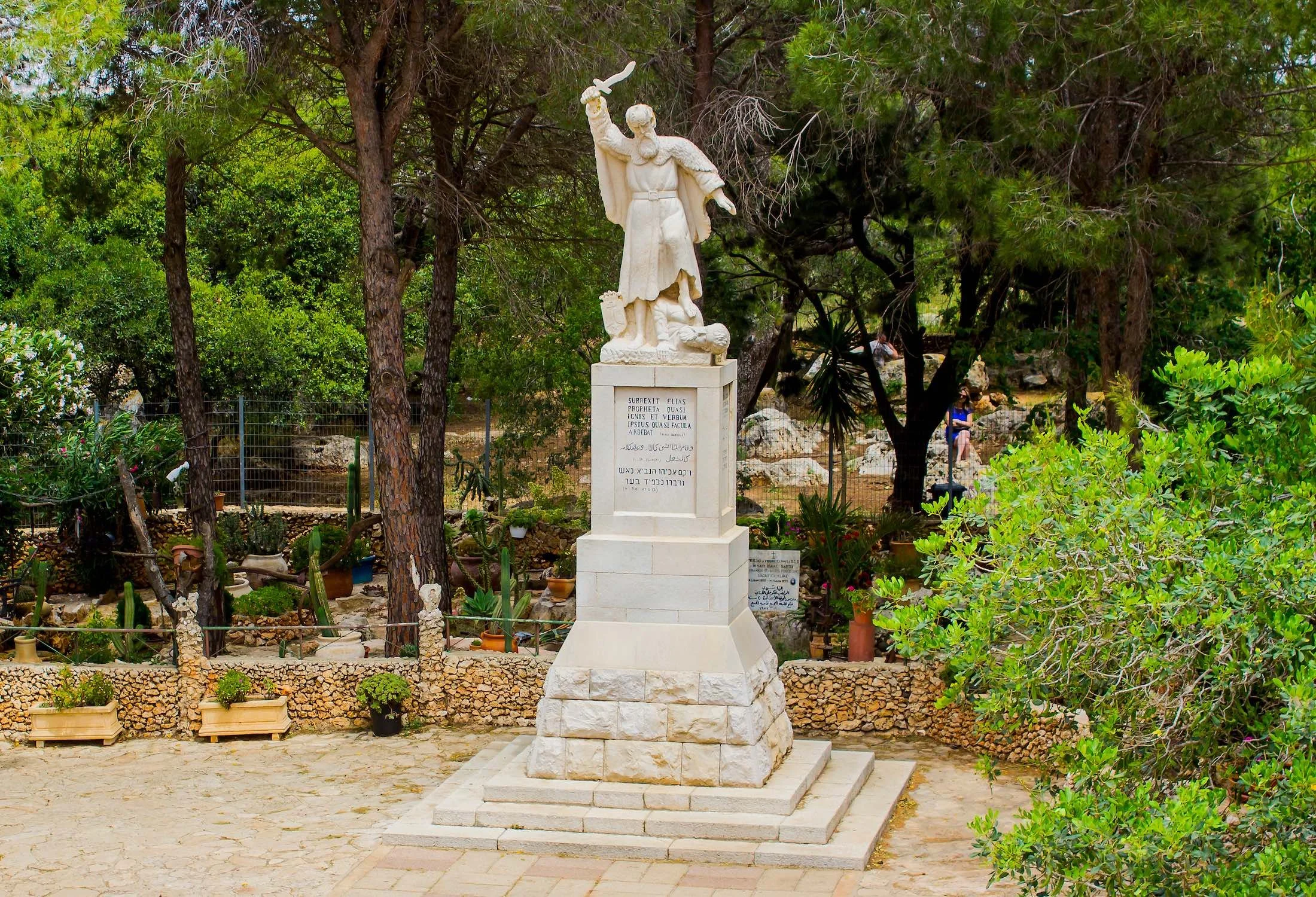
I have been to this site on Mount Carmel.
In 1914, the Carmelite monks erected a statue depicting a ten-foot tall Elijah holding a prophet of Baal down with his foot and stabbing him with a sword.
I do not know if that is how it happened, but if you stand before that statue, you will never forget it.
God's Questions on Mount Carmel
When we look at this historical event, three simple questions demand our attention...
I. What are your Baals?
1 Kings 18.18 | He replied, “I have not ruined Israel, but you and your father’s family have, because you have abandoned the Lord’s commands and followed the Baals. (CSB)
Why does Elijah say Baals instead of simply Baal?
Because false gods often wear many faces.
Because Baal was not merely a statue.
Because Baal represented whatever people believed could give them what they wanted.
Why did Israel chase Baal worship?
Because Baal promised things people crave.
Rain for crops.
Fertility for families.
Prosperity for business.
Power over enemies.
Pleasure for the flesh.
Their great sin was not always that they formally rejected the Lord.
Their great sin was that they tried to keep the Lord while also chasing idols.
They wanted Yahweh for tradition...
And Baal for results.
That is still the danger today.
We may not bow before carved images...
But many still trust modern Baals.
What are the Baals of our age?
Baals...
Financial security apart from trusting God.
Sexual fulfillment apart from God’s design.
Career success at any moral cost.
Popularity and approval.
Comfort and ease.
Political power for power sake.
Pleasure without repentance.
Self as ultimate authority.
A Baal is anything you look to and say:
“If I have this, I’ll be okay.”
“If I lose this, life is over.”
“I need this more than I need obedience to God.”
The issue is not possession.
The issue is devotion.
It is possible to sing in church on Sunday...
And serve Baal all week long.
So let me ask you plainly:
What competes with Christ in your heart?
What are you pursuing outside of God’s will?
What do you fear losing more than you fear dishonoring God?
Mount Carmel asks every generation the same question:
What are your Baals?
II. What do you need to repair?
1 Kings 18.30 | Then Elijah said to all the people, “Come near me.” So all the people approached him. Then he repaired the Lord’s altar that had been torn down: (CSB)
Have you noticed how quickly an abandoned building begins to fall apart?
The windows crack...
Weeds push through the concrete...
Paint peels from the walls...
Water finds its way through the roof...
Before long what once held life now looks hollow and broken.
It does not take long for neglect to destroy something that was once useful and valuable.
That is what happened to the Lord's altar on Mount Carmel.
The altar had once stood strong.
It had once been built for worship.
It had once been a place of sacrifice.
It had once been honored.
But now it was torn down.
It had been neglected...
It had been ignored...
It had been unprotected...
THE SAME THING CAN HAPPEN SPIRITUALLY.
A prayer life once strong can crumble.
Joy in worship can fade.
Love for Scripture can weaken.
Convictions can loosen.
Marriages can drift.
Families can cool toward God.
Hearts can grow hard slowly, quietly, almost unnoticed.
That altar on Carmel was made of stones.
But many people in this room have broken altars made of habits, priorities, relationships, and obedience.
Elijah repaired it.
Some of us want fire from heaven while ignoring broken stones on the ground.
But often God begins renewal where honesty begins.
So let me ask you:
What in your life has been torn down?
What have you neglected that once mattered?
What holy habit has fallen into disrepair?
What obedience have you delayed?
What might repairing look like?
Confession instead of excuses.
Repentance instead of delay.
Returning to church faithfully instead of casually.
Daily Scripture instead of spiritual starvation.
Prayer instead of panic.
Reconciliation instead of pride.
Immediate obedience instead of endless good intentions.
You do not need to rebuild everything today.
But you may need to pick up the first stone.
Before rain came to Israel...
Before fire fell on Carmel...
The altar was repaired.
What do you need to repair?
III. How long?
1 Kings 18.21 | Then Elijah approached all the people and said, “How long will you waver between two opinions? If the Lord is God, follow him. But if Baal, follow him.” But the people did not answer him a word.(CSB)
This may be the sharpest question in the whole chapter.
Elijah does not ask:
How informed are you?
How emotional are you?
How religious are you?
How sincere are you?
He asks:
How long?
In other words:
How long will you delay?
How long will you hesitate?
How long will you limp between two loyalties?
How long will you try to keep one foot with God and one foot with the world?
Notice Elijah says they were wavering between two opinions.
The word carries the idea of limping, hobbling, staggering.
They were spiritually unstable.
Not openly pagan.
Not wholeheartedly faithful.
Not fully against God.
Not fully surrendered to God.
And many people still live there.
Interested in Jesus...
But ruled by something else.
Convicted...
But unchanged.
Near the kingdom...
But not in it.
Present in church...
But absent in heart.
Half-heartedness feels safer than surrender.
But divided hearts are miserable hearts.
You cannot enjoy peace with one foot in rebellion.
Notice the tragedy of the next phrase:
But the people did not answer him a word.
Silence can be loud.
Silence can mean conviction.
Silence can mean pride.
Silence can mean fear.
Silence can mean, “Not today.”
Some of the most dangerous words ever spoken are never spoken aloud.
“Later.”
“Someday.”
“When life settles down.”
“After I enjoy this season.”
“When I get older.”
“When I am ready.”
But delayed obedience is still disobedience.
The crowd on Carmel wanted rain without repentance.
Many still want:
Blessing without surrender...
Peace without holiness...
Heaven without Christ’s lordship...
Rescue without repentance...
Elijah narrows the options:
Options
If the Lord is God, follow him.
If Baal is god, follow him.
In other words:
Choose your master.
Choose your path.
Choose your future.
Neutrality is an illusion.
Refusing to choose is already a choice.
So let me ask plainly:
How long will you postpone salvation?
How long will you excuse compromise?
How long will you carry secret sin?
How long will you resist what you already know God is telling you to do?
How long will you remain divided?
Some decisions shape all the days that come after them.
This may be one of those days.
Today can be:
The day you finally surrender...
The day you come home...
The day you lay down the idol...
The day you stop wavering...
The day you follow Christ fully...
Mount Carmel still asks:
How long?
Conclusion
There is something strange about this event...
When the fire of judgment came down, it only consumed the altar...
1 Kings 18.38 | Then the Lord’s fire fell and consumed the burnt offering, the wood, the stones, and the dust, and it licked up the water that was in the trench. (CSB)
It DID NOT consume the people!
Why not?
They were guilty...
They had rebelled...
In his mercy, the Lord allowed the altar to serve as a substitute for the people.
This points to something similar but greater...
Jesus bore God's wrath as our substitute!
GOSPEL